

Sage branding itself on trust in AI world of 'big voices'
Wed, 29th Apr 2026
The Bay Area is brimming with billboards advertising AI solutions that will "cut workforce by half" or have employees "operate as efficiently as 10 employees on their own." That being said, Sage, which has planted its flagship North American conference in downtown San Francisco, seems to be taking the opposite approach.
Tech companies in Silicon Valley and beyond are trying to gain customers' trust in the unreliable AI world of bad data and hallucinations. The cloud business management software firm is trying to earn that trust.
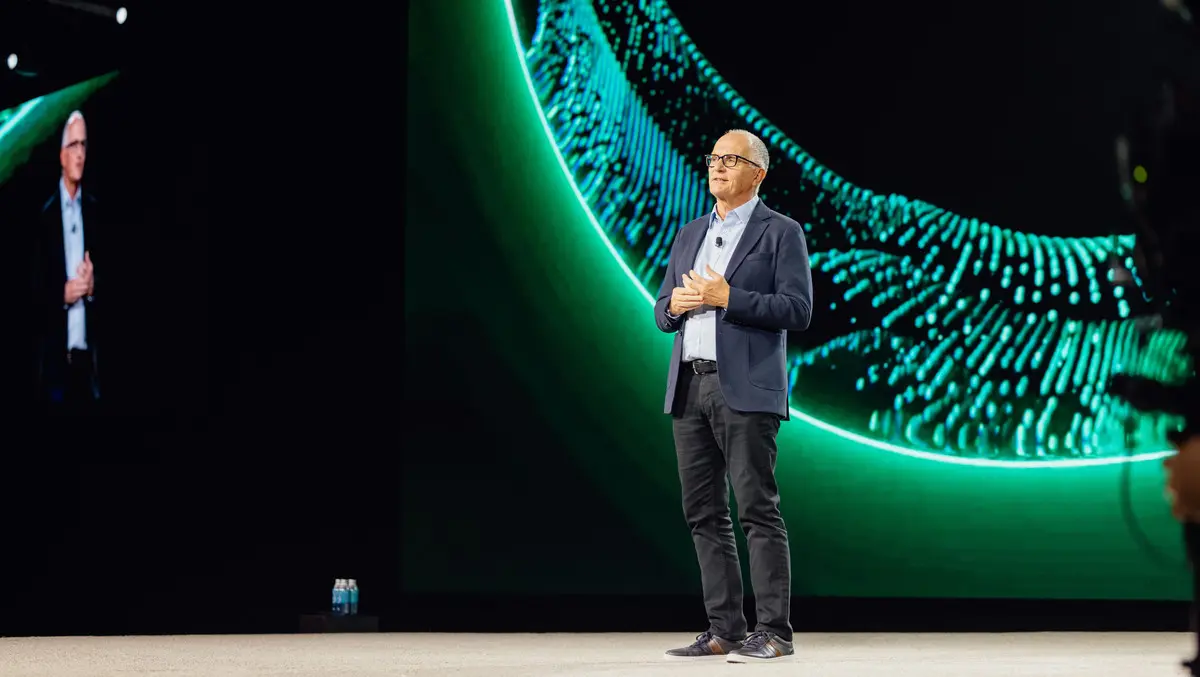
Sage CEO Steve Hare opened this year's Future event with a sentiment echoed by executives on stage throughout the conference: when the CFO's AI messes up, it's the CFO who gets called into the boardroom. Accountability is always on the person, no matter how efficient the AI is.
"I've been a CFO. I know what it's like when markets move and confidence drops...Everyone looks to the CFO to be the calm one in the room. When the numbers are challenged, it won't be the AI agent that gets called into the boardroom," said Hare. "As a CEO, I also see the scale of opportunity in principles, and I think it is enormous. That's why getting this right matters so much, because AI can do extraordinary things if it is built and applied in the right way."
He also warned against over-reliance on generic, off-the-shelf AI tools, noting that while outputs may appear polished and convincing, they can mask underlying inaccuracies. Likening Sage products as purpose-built for professionals engaged in high-stakes, "serious" work, where precision and accountability are non-negotiable.
San Francisco, the supposed AI capital of the world, has seen a surge in real estate prices, infrastructure announcements and tech company success in recent years. The region is home to OpenAI and Anthropic, both headquartered in the city, which jointly could be worth nearly USD 2 trillion, according to secondary market share sales.
Hare likened the vibrancy of the Bay Area's AI explosion to the California Gold Rush of the 19th century. While people once came to the Golden State in search of quick golden riches, today they come to build AI and boost performance more quickly. It's reflected in the billboards and on the streets.
"This city is in the middle of another rush, only this time it's not gold, it's AI. This is a huge moment. It's already reshaping how businesses operate, how decisions get made, and what performance looks like. And that's exciting. It should be exciting," said Hare. "I see a future where every business has intelligence built into the way it grows. I see finance students working with systems that can analyse, recommend and act alongside them every day, where the close is faster, planning is sharper, insight becomes quicker."
Sage guest and veteran tech journalist Kara Swisher said the lack of trust stems from big voices in the valley scaring the public.
While the "death" of San Francisco has been declared time and again, it is still going strong on the cusp of the latest AI tech. Swisher argued that the current phase is a top-down revolution, with AI executives holding the power but not the accountability when things go wrong.
She added that "big voices" in the valley have been allowed to operate with limited regulation, leading to a loss of public trust in the technologies that generate substantial value for the parent organisation. While she is not a fan of huge regulation, Swisher emphasised how there is virtually no regulation.
"The adoption of AI is really going to be dictated by how people feel about it, adopt it and use it. So the technology oftentimes does the humility for people to use it and kind of make them slightly more comfortable with the technology. So the ability to demystify it and to help people understand is how it can serve us too," Swisher said.
The term "glass box" is frequently used in Sage's reliance on trust as its differentiator. The firm advocates for customers to see the reasoning behind AI-made actions. Whereas when an answer is not cited, referred to as black box AI, Hare said that kind of hidden operation doesn't cut it in the finance function.
"When you have that confidence and stop managing from a place of anxiety, you start leaning in a position of strength. That's why glass box AI is so important to us," said Hare.
For Swisher, one focus she emphasised is on keeping humans at the centre of operations, especially when actions can be consequential.
"It's all being sold as replacements, and not human-centred AI," said Swisher. "AI can change your life in really positive ways. It can be a tool or a weapon. It's a weapon right now because it sounds like a weapon, it feels like a weapon. Anything anybody here can do to make it help people and help humanity is always positive. In the end, if the machines are running everything, and the rest of us are sitting in batteries for it, it's not gonna be much business, right?"